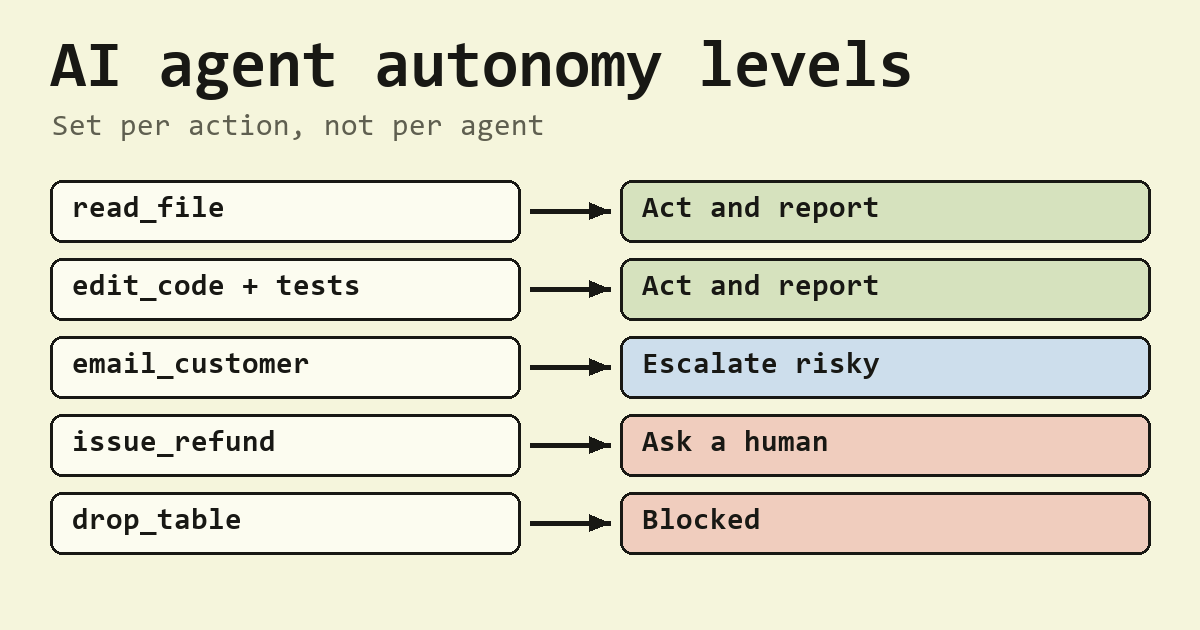
AI agent autonomy levels describe how many decisions an agent may take, and how many of its actions take effect without a person looking first. Autonomy is a dial, not a switch, and the right setting is the one with the lowest total cost: the time people spend reviewing, plus the harm from mistakes that review fails to catch. That cost differs from one action to the next, so a single agent should run at different levels for different actions.
Most pages on this topic give you a ladder of levels and stop there. This post goes one step further. It shows how to pick a level for each action an agent can take, with the arithmetic behind it and a few lines of code that enforce the choice.
Table of Contents
AI agent autonomy levels, from advise to fully autonomous
Think about how a new hire earns trust. On day one, they draft emails and you send them. After a month, they send routine emails themselves but ask before anything involving money. After a year, they handle most things and tell you afterwards. Nobody hands a new hire the company credit card on day one, and nobody makes a senior colleague ask permission to send a meeting invite. Authority is set per kind of action, based on the stakes and the track record.
Agents work the same way. Researchers in human and automation interaction have described automation as graded levels for decades, starting with Sheridan and Verplank in 1978 and refined by Parasuraman, Sheridan, and Wickens in 2000. For AI agents, a practical ladder has six rungs:
| Level | Name | What the agent may do |
|---|---|---|
| 0 | Advise | Suggest. A human performs every action. |
| 1 | Draft | Prepare actions, such as a reply or a code change. A human reviews and applies each one. |
| 2 | Act with approval | Execute actions, each only after explicit approval. |
| 3 | Act, escalate risky | Execute routine actions, and ask before risky or irreversible ones. |
| 4 | Act and report | Execute everything within its permissions. A human audits afterwards. |
| 5 | Fully autonomous | Pursue goals with no routine human involvement. |
You will find other ladders too. Feng, McDonald, and Zhang (Levels of Autonomy for AI Agents, 2025) define five levels by the role the user plays: operator, collaborator, consultant, approver, and observer. The Cloud Security Alliance publishes its own L0 to L5 scale, which echoes the SAE J3016 levels used for self-driving cars. They are useful vocabulary. The trouble is that a level is usually assigned to a whole agent, and that is where things go wrong.
Why one autonomy level per agent is the wrong unit
Take a coding agent. It reads files, runs tests, edits code, pushes to the main branch, and runs database migrations. Reading a file has almost no downside. Running a migration on production can take a business offline. If you set one level for the whole agent, you either supervise the harmless actions so much that people stop paying attention, or you supervise the dangerous ones too little.
So the useful question is not “what level is this agent?” It is “what level should each action run at?” To answer that, you need to put a price on oversight.
The cost of oversight, in one formula
Suppose an agent takes n actions in a week. Each one is wrong with probability p, and a wrong action that nobody catches causes harm H on average. A person reviews a fraction f of the actions, at a cost R per review. The reviewed actions contain a share s of all the errors, and the reviewer catches an error they see with probability q. The expected cost is:
Expected cost = n × f × R + n × p × (1 − s × q) × H
The first term is the time people spend reviewing. The second is the harm from errors that get through. Full autonomy sets f to 0, so you pay nothing for review and all of the harm. Approving everything sets f and s to 1, so you pay for every review and only miss the errors reviewers overlook. Where the minimum sits depends on the numbers, which is exactly why no single level is right for every action.
The share s is the interesting part. If you review a random 10% of actions, you see about 10% of the errors. If a simple risk check picks which 10% to review, you can see most of them. Targeting is what makes partial review worth doing.
Reversibility and verifiability set the stakes
Two properties of an action decide most of this. The first is how easy it is to undo. A draft, an edit under version control, or a change in a test environment is cheap to reverse, so H is small. A payment, a sent email, a deleted production table, or a public post is not, so H is large.
The second is how easy it is to check. If tests, validators, or a type checker catch errors automatically, fewer errors reach a person, which lowers the effective p. Actions that are both reversible and checkable are the safe place for high autonomy. That is one reason coding agents became practical early: code changes can be tested, reviewed, and reverted.
| Action | Reversible? | Checkable? | Sensible starting level |
|---|---|---|---|
| Read a file or search the web | Nothing to undo | Yes | Act and report |
| Edit code with tests | Yes, with version control | Yes, tests run | Act and report |
| Draft a document | Yes | A person reads it anyway | Draft |
| Email a customer | No | Partly | Act, escalate risky |
| Issue a payment or refund | No | Partly | Act with approval |
| Migrate or delete production data | Hard | Hard | Act with approval, or not at all |
The last column is a starting point, not a rule. The arithmetic in the next section is what decides.
A worked example with an email agent
An agent sends 1,000 customer emails a week, and 2% of them are wrong in some way, so 20 errors a week. A review takes 30 seconds of someone paid $60 an hour, which is $0.50, and a reviewer catches 90% of the errors they see. A small risk classifier flags 10% of emails for review, and those flagged emails contain 80% of the errors.
Now compare three settings, for two kinds of email.
| Setting | High stakes (H = $200) | Low stakes (H = $5) |
|---|---|---|
| Act autonomously | $4,000 | $100 |
| Approve flagged emails (10%) | $1,170 | $78 |
| Approve every email | $900 | $510 |
For billing disputes, where a wrong email costs about $200, approving everything is cheapest on paper. For meeting reschedules, where a wrong email costs about $5, approving everything is the most expensive option by far, and targeted review wins. Same agent, same week, different answers. That is the whole argument for setting autonomy per action.
Here is how the high-stakes, flagged row is built, so you can check it. Review costs 100 × $0.50 = $50. The errors that get through are 20 × (1 − 0.8 × 0.9) = 5.6, and 5.6 × $200 = $1,120. Add them and you get $1,170.
Human in the loop AI agents, and why approval fatigue matters
A human in the loop AI agent is one where a person has to approve some or all of its actions before they take effect. It sounds like the safe default, and for a few actions it is. Applied to everything, it backfires.
The reason is people, not models. Someone asked to approve hundreds of routine actions soon approves without reading, so the catch rate q drops. Lisanne Bainbridge described this in her 1983 paper “Ironies of Automation”: people are poor at watching over automation that is usually right. The more reliable the system looks, the less attention a monitor pays to it.
Put that into the email example. If constant approvals make reviewers careless enough that q falls from 0.9 to 0.5, approving every high-stakes email costs $500 + 20 × 0.5 × $200 = $2,500. That is more than twice the $1,170 of targeted review. Asking for approval on everything did not make the system safer. It made the approvals meaningless.
So keep approvals rare enough that the person giving them still reads them. Spend human attention on the risky few, and let the harmless many run.
Earning more autonomy with evidence
An agent’s autonomy should rise as its measured error rate on a class of actions falls, the same way you extend trust to a new colleague. The difference is that with an agent you can measure it properly:
- Start low, at Draft or Act with approval, for every action that is hard to undo.
- Log every action and its outcome, including the ones a reviewer corrected.
- Measure the error rate p for each type of action, not for the agent as a whole.
- Raise autonomy only for action types where measured errors are both rare and cheap, and lower it again if the rate rises after a model or prompt change.
One more lever is often better than adding approvals: make the action itself safer. A dry run, a staging environment, a delayed delete, or a test suite lowers H or p directly, and then a higher autonomy level becomes the cheaper one.
The code for choosing a level
This runs with plain Python and reproduces the email example. Change the numbers to match your own agent:
def weekly_cost(n, p_err, harm, review_cost, catch, reviewed_frac, error_share_in_reviewed):
    """Expected cost = human review time + harm from errors that slip through."""
    errors = n * p_err
    caught = errors * error_share_in_reviewed * catch
    return n * reviewed_frac * review_cost + (errors - caught) * harm

for harm in [200, 5]:
    levels = {
        "act autonomously":      weekly_cost(1000, 0.02, harm, 0.50, 0.9, 0.0, 0.0),
        "approve flagged (10%)": weekly_cost(1000, 0.02, harm, 0.50, 0.9, 0.1, 0.8),
        "approve every action":  weekly_cost(1000, 0.02, harm, 0.50, 0.9, 1.0, 1.0),
    }
    print(f"harm ${harm}:", {k: round(v) for k, v in levels.items()}, "-> best:", min(levels, key=levels.get))

# Rubber-stamping: the catch rate falls when every action needs approval
print("approve all, careless reviewers:", round(weekly_cost(1000, 0.02, 200, 0.50, 0.5, 1.0, 1.0)))
Running it prints:
harm $200: {'act autonomously': 4000, 'approve flagged (10%)': 1170, 'approve every action': 900} -> best: approve every action
harm $5: {'act autonomously': 100, 'approve flagged (10%)': 78, 'approve every action': 510} -> best: approve flagged (10%)
approve all, careless reviewers: 2500
Enforcing the level in the harness
Once you have decided, the level has to live in code, not in the prompt. In the agent loop, the model proposes an action and the harness runs it, so the harness is the right place to check the policy. Here is the smallest useful version:
# A per-action autonomy policy: the harness, not the model, decides what needs a human.
POLICY = {
    "read_file":      "auto",       # reversible, harmless
    "run_tests":      "auto",
    "edit_file":      "auto",       # reversible with version control, checked by tests
    "send_email":     "approve",    # cannot be unsent
    "issue_refund":   "approve",    # moves money
    "drop_table":     "deny",       # never from an agent
}

def gate(tool):
    rule = POLICY.get(tool, "approve")   # unknown tools default to asking a human
    return {"auto": "RUN", "approve": "ASK A HUMAN", "deny": "BLOCKED"}[rule]

for tool in ["read_file", "edit_file", "send_email", "drop_table", "new_tool"]:
    print(f"{tool:12} -> {gate(tool)}")
Output:
read_file    -> RUN
edit_file    -> RUN
send_email   -> ASK A HUMAN
drop_table   -> BLOCKED
new_tool     -> ASK A HUMAN
Two details matter. The policy is a table keyed by action, not a single setting for the agent. And an action nobody classified defaults to asking a human, so adding a new tool never silently grants it full autonomy.
Signs your autonomy setting is wrong
- An agent was given full autonomy over payments because it did well in demos.
- An agent asks permission for every file read, and people now click “approve” without looking.
- Nobody has measured error rates per type of action, so autonomy is never raised or lowered on evidence.
- Routine and high-impact actions sit under the same approval rule.
Test yourself
- Why should autonomy be set per type of action rather than per agent?
- An agent takes 500 actions a day, 1% are wrong, and each uncaught error costs $50. A review costs $0.40 and catches 95% of errors. Compare the daily cost of full autonomy with approving every action.
- What would happen if a team required approval for every action of a coding agent, including reading files and running tests?
Answers
- Because the expected cost depends on each action’s error rate, harm, reversibility, and checkability, and these differ enormously between actions of the same agent, such as reading a file and sending a payment. One setting would either over-supervise harmless actions, which trains people to rubber-stamp, or under-supervise dangerous ones.
- There are 5 errors a day. Full autonomy costs 5 × $50 = $250. Approving everything costs 500 × $0.40 = $200 in review, plus 5 × 0.05 = 0.25 missed errors × $50 = $12.50, so $212.50. Approving everything is slightly cheaper here, and targeting reviews at riskier actions might beat both.
- Developers would face dozens of prompts per task for actions with no real risk. They would start approving without reading, so the catch rate for the actions that do matter, such as pushing code or running migrations, would fall as well. Productivity drops and safety may not improve.
What this connects to
This post builds on the agent loop and on two ideas from earlier in the series: an agent’s actions are sampled, so errors are a rate rather than a surprise, and agents own their control flow, which is why their actions need gates at all. Next in the series is function calling, the mechanism that turns a model’s text into an action your harness can check.
Sources
- Thomas B. Sheridan and William L. Verplank, Human and Computer Control of Undersea Teleoperators, technical report, MIT Man-Machine Systems Laboratory (1978).
- Raja Parasuraman, Thomas B. Sheridan, and Christopher D. Wickens, “A Model for Types and Levels of Human Interaction with Automation,” IEEE Transactions on Systems, Man, and Cybernetics, Part A 30, no. 3 (2000): 286 to 297.
- Lisanne Bainbridge, “Ironies of Automation,” Automatica 19, no. 6 (1983): 775 to 779.
- K. J. Kevin Feng, David W. McDonald, and Amy X. Zhang, “Levels of Autonomy for AI Agents,” arXiv:2506.12469 (2025). https://arxiv.org/abs/2506.12469
- SAE International, J3016, “Taxonomy and Definitions for Terms Related to Driving Automation Systems for On-Road Motor Vehicles.”
Written by Kauntey Acharya. More about this site on the About page.